Motorcycle Tyre Pressure: How Much, and How to Check It
By Bruno Passos · Founder of Cornr
Published November 27, 2026 · 6 min read
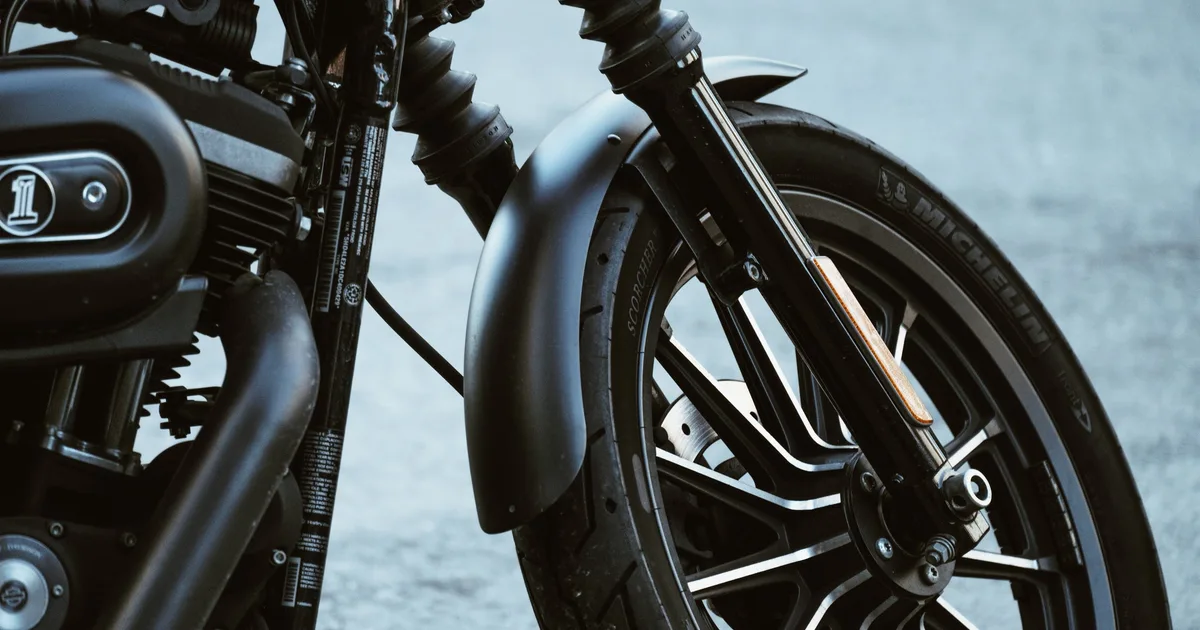
Run the tyre pressures your motorcycle's maker recommends. They're in the owner's manual and usually on a sticker on the swingarm, the chain guard or under the seat. They are cold pressures: check them before you ride, with your own gauge, about once a week. The number moulded into the tyre's sidewall is the most the tyre can hold, not what to run.
Temperature changes the reading more than most riders expect. Cornr rides in Brazil this year started at anything from 10°C to 39°C, and a typical ride starting around midday began about 6°C warmer than one starting before 9 am. That's enough to move the gauge by about 1 psi before you've ridden a metre.
What tyre pressure should your motorcycle have?
The figure for your bike, front and rear, from the manual or the sticker. There is no single right number for all motorcycles, and the rear usually runs higher than the front because it carries more of the weight. Three manuals show how much they vary:
| Bike (manual) | Front | Rear, solo | Rear, two-up |
|---|---|---|---|
| Yamaha MT-03 (Europe) | 29 psi (200 kPa) | 36 psi (250 kPa) | 36 psi (250 kPa) |
| Yamaha FZ25 (Argentina) | 25 psi (175 kPa) | 29 psi (200 kPa) | 29 psi (200 kPa) |
| Honda XR300L Tornado (Argentina) | 22 psi (150 kPa) | 22 psi (150 kPa) | 29 psi (200 kPa) |
Some manuals, like Honda's for the Tornado, give a higher rear figure for riding with a passenger. Others, like Yamaha's, give one figure and tell you to adjust for the total load and for sustained high speed. Read the notes beside the table before a trip two-up or with luggage.
Pressures appear in psi, bar or kPa, sometimes in kgf/cm² on bikes sold in Brazil. 1 bar is about 14.5 psi, 100 kPa is 1 bar, and 1 kgf/cm² is about 14.2 psi.
Don't take the number from the sidewall. That's the tyre's maximum, the same whichever bike it's fitted to, and running it makes the tyre hard, with less rubber on the road.
Why do you check tyre pressure cold?
Because the recommended figures are cold figures, and riding heats the tyre. Riding raises the pressure by 4 to 6 psi or more, which is normal and already allowed for. "Cold" means before you ride, or after the bike has stood for at least three hours, by Michelin's definition.
Two things follow:
- Never let air out of a warm tyre to bring it down to the cold figure. Once it cools, it will be under-inflated.
- If you had to ride to the air pump, never set it below the cold figure, and check again with your gauge the next morning, cold, to correct it.
How much does the weather change tyre pressure?
About 1 psi for every 6°C (10°F), by Michelin's rule of thumb. Air expands as it warms, so a tyre set on a cool morning reads higher by mid-afternoon without being ridden, and a tyre set on a hot day reads low on a cold morning.
Here is the temperature at the start of 1,045 rides that 568 Cornr riders recorded in Brazil in 2026, by the time the ride began:
| Ride started | Typical temperature at the start |
|---|---|
| Before 9:00 | 23°C |
| 9:00–12:00 | 27°C |
| 12:00–15:00 | 29°C |
| 15:00–18:00 | 27°C |
| After 18:00 | 24°C |
Between a typical early start and a typical midday one that's about 1 psi. Across the whole range, from the coldest ride start (10°C) to the hottest (39°C), it's about 5 psi, which is the difference between a tyre that's right and one that's clearly soft. The simple habit that removes all of this: check in the morning, before the first ride of the day, and in the same conditions each time.
How do you check motorcycle tyre pressure?
- Use your own gauge. A pencil, dial or digital gauge costs little, and you'll always be comparing like with like. Petrol-station gauges take a lot of abuse.
- Start with cold tyres. Unscrew the valve cap and keep it somewhere you won't lose it.
- Press the gauge squarely onto the valve until the hiss stops, and read it.
- Compare with the cold figure for how you're riding today: solo or two-up.
- Add air in short bursts and measure again, or press the valve core briefly to let some out.
- Screw the cap back on. It keeps dirt out of the valve, which is what actually holds the air.
While you're down there, look at the tread: check it against the wear bars in the grooves, and look for cuts, embedded stones, bulges and cracks in the sidewall.
How often should you check your tyre pressure?
About once a week, and before any long trip or a day carrying a passenger. Honda's Brazilian manuals for bikes such as the CG 160 ask for a check every 1,000 km or every week; Michelin says before every ride. The Motorcycle Safety Foundation's pre-ride checklist, T-CLOCS, starts with the tyres: pressure checked cold and set for the load. Motorcycle tyres lose a little air over time even when nothing is wrong, and a slow puncture shows up first as a tyre that needs topping up more often than the other.
What happens if your tyre pressure is too low or too high?
- Too low: the steering gets heavy and vague, the tyre flexes and builds up heat, it grips less in corners and wears faster at the edges. A soft rear feels unstable when you accelerate and brake, and a badly under-inflated tyre can fail suddenly at speed.
- Too high: the tyre stands up stiffer, with a smaller contact patch, so there's less grip, especially on cold or wet roads. The ride gets harsh and nervous, and the centre of the tread wears faster.
Neither is subtle once you know to look for it. If the bike suddenly feels vague or reluctant to turn, check the pressures before anything else.
Does tyre pressure matter more in the rain?
Grip is thinner in the wet, so the margin a correctly inflated tyre gives you matters more, and a tyre that's both worn and soft clears water worst of all. Our guide to riding a motorcycle in the rain covers the rest; there is no special "rain pressure", just the right one.
Where these numbers come from
When a ride starts, Cornr records the weather that the forecast service (Open-Meteo) reports for the rider's location. We used rides longer than 2 km recorded by Cornr riders in Brazil in 2026: 1,045 rides by 568 riders, with times in Brasília time. Each time band includes more than 100 riders. The pressure change per degree is Michelin's rule of thumb, about 1 psi per 6°C (10°F), which holds at normal motorcycle pressures.
Sources
- Michelin USA: Ride safely with Michelin motorcycle tires
- Michelin Canada: Motorcycle tire pressure safety tips
- Michelin USA: Winter tire timing and PSI tips (about 1 psi per 10°F)
- Motorcycle Safety Foundation: T-CLOCS pre-ride inspection checklist (PDF)
- Yamaha Motor Europe: MT-03 (MTN320-A) owner's manual, 2020, tyre pressures
- Yamaha Motor Argentina: FZ25 (FZN250) owner's manual, 2017 (Spanish), tyre pressures
- Honda Motor Argentina: XR300L Tornado owner's manual, 2025 (Spanish), tyre pressures
- Honda: CG 160 Fan / Titan owner's manual, 2025–2026 (Brazil, Portuguese): tyres, check and set every 1,000 km or weekly
- Cornr data: temperature at the start of 1,045 rides by 568 Cornr riders in Brazil, 2026